Showing posts with label Baltic Coast. Show all posts

Friday, November 18, 2011

The Amber Room—A Lost World

  One spring afternoon, while Manya was walking down the garden path, she saw Joshi running toward her past the beds of purple irises. Breathless, he handed her a rough piece of amber. “For you,” he said. “East Prussian gold. I found it myself by the Baltic Sea on the beach near Kahlberg. Look! It even has a butterfly inside. Mama says butterflies are a symbol of change.”
  “It’s beautiful,” she murmured, holding it up to the light. “But why are you giving it to me?”
  He laughed. “Because you’re my best friend.” 


—Excerpt from The Last Daughter of Prussia                                                                   

A beautiful Trakehner who like amber is a symbol of East Prussia
 This picture is from the book Trakehnen's Pferde by Erhard Schulte
Photo:Graf 
  
  Last week I wrote about my mother's amber—a glowing orange piece of Baltic resin that prompted an East Prussian family friend to tell me her tragic story after years of keeping it to herself. As I  thought  more about what I had written, I realized that this woman's story must have lain dormant in the recesses of my unconscious for decades—almost like the amber that lies embedded in the earth's mantle under the sea. Then, when I finally decided to write The Last Daughter of Prussia the piece of amber my mother had given me seemed to surface, becoming—metaphorically speaking—alive with scenes of history it had witnessed in WW2 and prompting me to bring awareness not only to the plight of the East Prussian people and their brave Trakehners, but also to the holocaust that brought death to so many Roma gypsies and Jews under Hitler's rule.

The Old Amber Room before WW2
  
  As I was researching amber I came across an interesting WW2 story regarding the disappearance of the famous Amber Room—an 11 foot square chamber fantastically decorated with several tons of amber panels carved with decorative figures and backed with gold leaf and mirrors. Due to its singular beauty, this room was dubbed "The Eighth Wonder of the World." Designed in the early 18th century by the German sculptor, Andreas Schlüter (an ancestor of my own grandmother Edith von Schlüter),  it was first installed at Charlottenburg Palace, home of Friedrich I, and later presented to the Russian Czar, Peter the Great who admired it on a visit to Berlin in 1717. The Amber Room was then transported to Russia and when Catherine the Great came to power she moved it to her summer palace in Tsarskoye Selo.

Catherine's Palace
  
  So that is a very brief background about the Amber Room. 
  Now, fast forward from that historical era to WW2 when the Germans were invading the Soviet Union. Apparently the Russian curators tried to dissemble the Amber Room, but over the years the resin had become brittle and started to crumble. In an attempt to keep the Nazi forces from seizing the treasure the curators tried to conceal it behind wallpaper but that effort failed. Within 36 hours German soldiers had dissembled the Amber Room and ordered the evacuation of 27 massive crates to Königsberg in East Prussia. Sadly, from that day on, the Amber Room was never seen again, though reports have occasionally surfaced stating that a few components survived the war and ended up on the black market. Some historians claim that the amber was burned by the Russians when they invaded Königsberg. Others say the crates went down with the Wilhelm Gustloff when the ship sank in the Baltic Sea. A few investigators even believe that the amber is hidden in a secret underground catacomb that Hitler had built for stolen war treasures. Until now though it has been lost. 
  You may ask why I'm writing all this. Well, after reading about the Amber Room, the carved golden images of that light-filled chamber would not leave me alone. No matter where I was—food shopping, cooking, walking the beach, they lit up my third eye and with them came East Prussian landscapes of swans floating on lakes, otters splashing in rivers and big-antlered elk moseying through forests of birch, lark and pine. I saw hardworking men and women humming and sweating as they worked the land with their bare hands. 

Swans on the Guja Lake in East Prussia
Photo (c) Gottlieb Family

Ingo, my mother's tame otter - he's not splashing in a river here
 but rather in her tub!
Photo (c) Gottlieb Family
   
  The more the images came, the more I sensed a connection between the disappearance of the famous Amber Room and the disappearance of East Prussia. Before the war both existed. After the war there was no Amber Room, no East Prussia. 

  As I pondered these losses I felt there was a correlating significance in their symbolism. Amber was an East Prussian specialty and the Amber Room was created out of tons of amber mined from that small province. Perhaps they both disappeared to show the world that looting and violence, greed and lack of respect for beauty, life and nature bring loss and separation. 


Baltic Amber Map
As you can see East Prussia no longer exists on maps today
but it used to be situated in that yellow-colored coastal area which is now labeled Russia and Poland
It was the area where most of the world's amber was mined. That is still the same today
 although now there are also mining sites in the Dominican Republic.

  Still, I'm hopeful that one day the Amber Room will reappear. If amber can last for millions of years, then those carved golden panels can remain buried in the earth or under the sea forever. And even if they are hidden they will continue hold the stories that belong to heart of history. 

The piece of East Prussian gold/amber my grandmother carried on the trek across the ice in WW2 .
She believed it would bring her luck.
In later years, she would press it to her ear and say she heard the heartbeat of her land.
Photo (c) Christine Matthäi
  
  As for me, I hope to give my piece of amber to my grandchildren and tell them the story of East Prussia and the Amber Room so they learn about the past and remember their heritage.

Replica of the Amber room


  (Note: In 1979 a reconstruction effort of the Amber Room began at Tsarskoye Selo based on the black and white photographs of the original chamber. With financial aid from the German company Ruhrgas AG the chamber was completed and dedicated by Russian President Vladimir Putin and German Chancellor Gerhard Schröder at the 300-year anniversary of the city of St Petersburg.)

Until next time...
—Marina Gottlieb Sarles

Tuesday, April 12, 2011

Revelations on Research and Writing

     When I set out to write my historical novel The Last Daughter of Prussia I had no idea how all-consuming it would be. I thought I'd bang out the chapters on my keyboard. What did I know about the depth of research this project would entail? Sometimes, I tried to sneak around it, write over it or under it, but that never worked. I learned all too quickly that writing fiction still demands facts.

    Characters in a story have a mind of their own. They want to choose what they are wearing and what they eat. They have likes and dislikes, customs and rituals and if these are not acknowledged they won't bare their souls or tell you about themselves. In fact, they'll stop you dead in your tracks. At least that's what mine did. So, desperate to engage them, I complied and went to work.

For example, a gypsy, such as the one in this picture, would have a distinct look.
However, the picture fixed in my mind wasn't right. I needed details like the sleeves, the scarf and the jewelry,
or this man who resembles Harmon,  one of the minor characters in my book, would not have been happy.


    One night while surfing the web, ( it was 2 am in the morning), I glimpsed my grandfather's name - Baron Walter von Sanden - sliding past me on the screen. I was tired and my eyelids felt like two scratchy burlap sacks full of German potatoes, but suddenly, the heaviness was gone. Scrolling up, I found a post by a man named Klaus Plikat describing his grandfather Gustav Plikat who had been a Master Mason on my grandfather's estate in East Prussia before 1924.  Klaus was asking if anyone remembered his grandfather or the von Sandens of Guja and Launingken, East Prussia. I nearly flipped. Was it possible? Could I make contact? The post was over two years old. All the same, I pounded out a letter.

Gustav and Berta Plikat. (courtesy of Klaus Plikat)
Gustav worked on my grandfather's estate as a Master Mason. 
Apparently. my grandparents always had an open house on Christmas Day. Everyone was welcome.
There was singing and lots of food and as Gustav Plikat was also a butcher, 
he slaughtered many a poor pig.

    
  The next morning, I rushed downstairs to find a response waiting in my inbox. Klaus wrote that he was elated to hear from me. He wanted to know what I knew. I answered saying that I had never been to East Prussia nor did I know his grandfather, but I certainly knew mine. Our friendship started right there and although I have never met Klaus in person - he lives in Alaska - we talk often - a boon for me as he has been a great help on my journey.

A bathing spot in the Angerapp River with a rope for swinging into the water
Like my grandfather, Gustav loved swimming and fishing in the Angerapp River


    While writing, I often hit roadblocks, tough ones that left me stymied. At one point, I couldn't figure out where the famous Trakehner Horse Farm in Braunsberg was located. Was it to the north or the south of the city? This was a crucial question because the answer involved the route my hero Joshi had to travel. I struggled over the matter for weeks. One day, as I was about to give up, Klaus called. Because he himself had researched his roots, he was in touch with knowledgable East Prussian sources.

    Within moments of speaking to Klaus, I had an e-mail address and phone number. Within hours, the puzzle fell into place and Joshi knew where he was headed. Some stranger, somewhere in Germany had shown him the way. I couldn't help but wonder. Was this coincidence?


Braunsberg
The city just to the east of the frozen part of the Baltic Sea
that my travelers must to cross to escape the Russian Army

Braunsberg was also home to the famous Braunsberger Trakehner Horse Farm

  
    As The Last Daughter progressed, I decided to fly to Gdansk -  a port on the Baltic coast (formerly known as Danzig, Prussia, now Poland). A big part of my story takes place there and I needed to do some research as my heroine Manya and her companions have to escape from that harbor on a barge - not an easy task during WW2 when thousands of refugees were trying to do the same. Again Klaus came to my aid. This time he sent an angel in person - Irek Golojuch - a German speaking Pole whom he'd befriended while researching family ties.

Irek meeting me at the Gdansk (Danzig) airport

    Irek was a godsend. Never, would I have found my way through Danzig without his assistance. He walked me through that beautiful gothic city, along the Lange Markt dotted with shops full of golden Baltic amber, past St Mary's - the largest red brick church in Europe - all places that I mention in my book. He showed me the shipyard - Kaiserliche Werft Danzig - also a vital scene in my story. Finally, he pointed out the Vistula Canal which opens up into the outer harbor of Neufahrwasser, and flows past the picturesque Westerplatte Peninsula, the site of the official start of WW2. All these places were important because my heroine saw them too.

Danzig - the port where my travelers try to find a way out to the west

Westerplatte in Danzig - the site of the official start of WW2 and where the Reich War Flag was hoisted
  
    Irek took so much time to explain things. He even drove me to Stutthof, the concentration camp some 36 kilometers to the east of Danzig where Joshi was imprisoned. There, he arranged a private museum showing with a lovely Polish girl, Joanna Szymanska, who would not accept a penny in tips, saying it was her duty to give back to the those who had suffered.

    Such was the kindness of strangers I encountered while writing my book. And all because I'd read an old post on the computer. Again I asked myself, could these experiences, so synchronistic in nature, be laughed away as coincidental? No. Something else was at work - some unknown yet organizing power -  and it was directing me. All I had to do was trust and follow. This realization has been one of the most important spiritual teachings given to me through the writing process.

Joanna with me in Stutthof
  
  
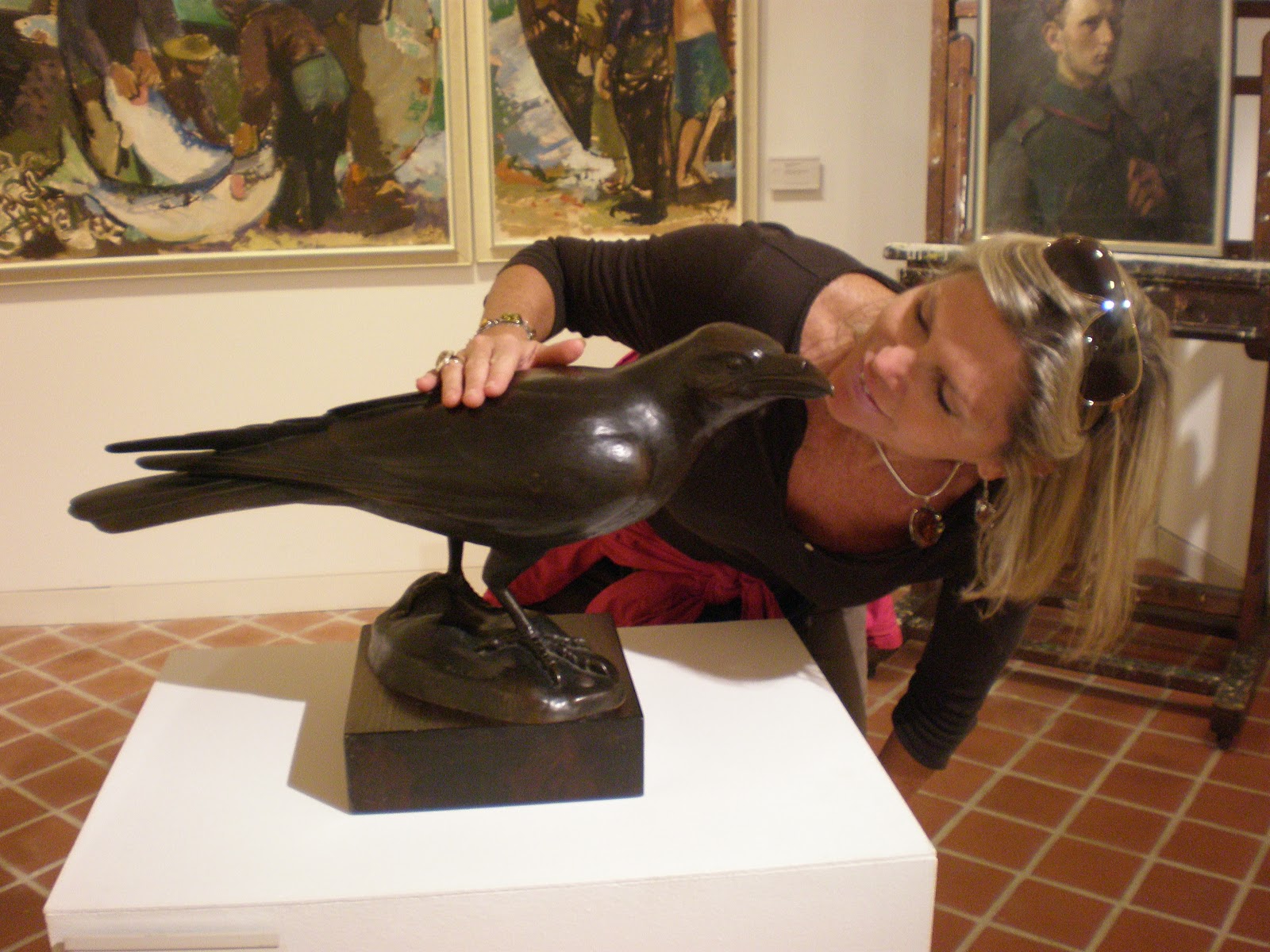
    After Danzig, I flew to Lüneburg (West Germany) where another kind friend of Klaus's, another stranger - Dr. Michael Otto - took me to The East Prussian Museum. Upon entering the first exhibition hall, I gasped. Standing before me on pedestals were two of my grandmother's bronze sculptures; Ingo, the otter, and Meister Eckhart, the raven - both her pets while she lived in East Prussia, as well as subjects for her artistic endeavors. Around me, on the walls, were stunning nature photographs of birds and lakes in East Prussia, rivers and people that my grandfather had captured through his camera lens years before. There were books too that he had written.

    I started to cry. How could this be? I hadn't known the far-reaching extent of their gifts. Just then, the museum curator arrived and seeing my tears he laid a gentle hand on my shoulder.

    "Your grandparents left  a legacy," he said proudly. "One of great importance - one that will help people remember the existence of a vanished land."

Ingo, the otter


Meister Eckhart, my grandmother's bronze raven pecking at my chin

  
    I nodded wordlessly. What could I say? And, as I stood there gazing at the sculptures, I felt a deep stirring inside, a shaking in my bones as if my ancestors were standing behind me in a great line, urging me on to complete my story.


(c) All content and photos are the private property of the Gottlieb family, unless otherwise stated or linked,  and may not be used without permission.
(c) Privatbesitz Gottlieb Familie